CPAP Adherence & Success
Sticking with CPAP therapy can be challenging, but it works best when used consistently. Use the tools below — a mask finder, a comfort ladder, and quick troubleshooting — to build a routine that lasts.
What is CPAP, and how does it work?
CPAP stands for continuous positive airway pressure. It is the most effective and most widely prescribed treatment for obstructive sleep apnea (OSA), and the recommended first-line therapy for most adults with moderate to severe OSA.
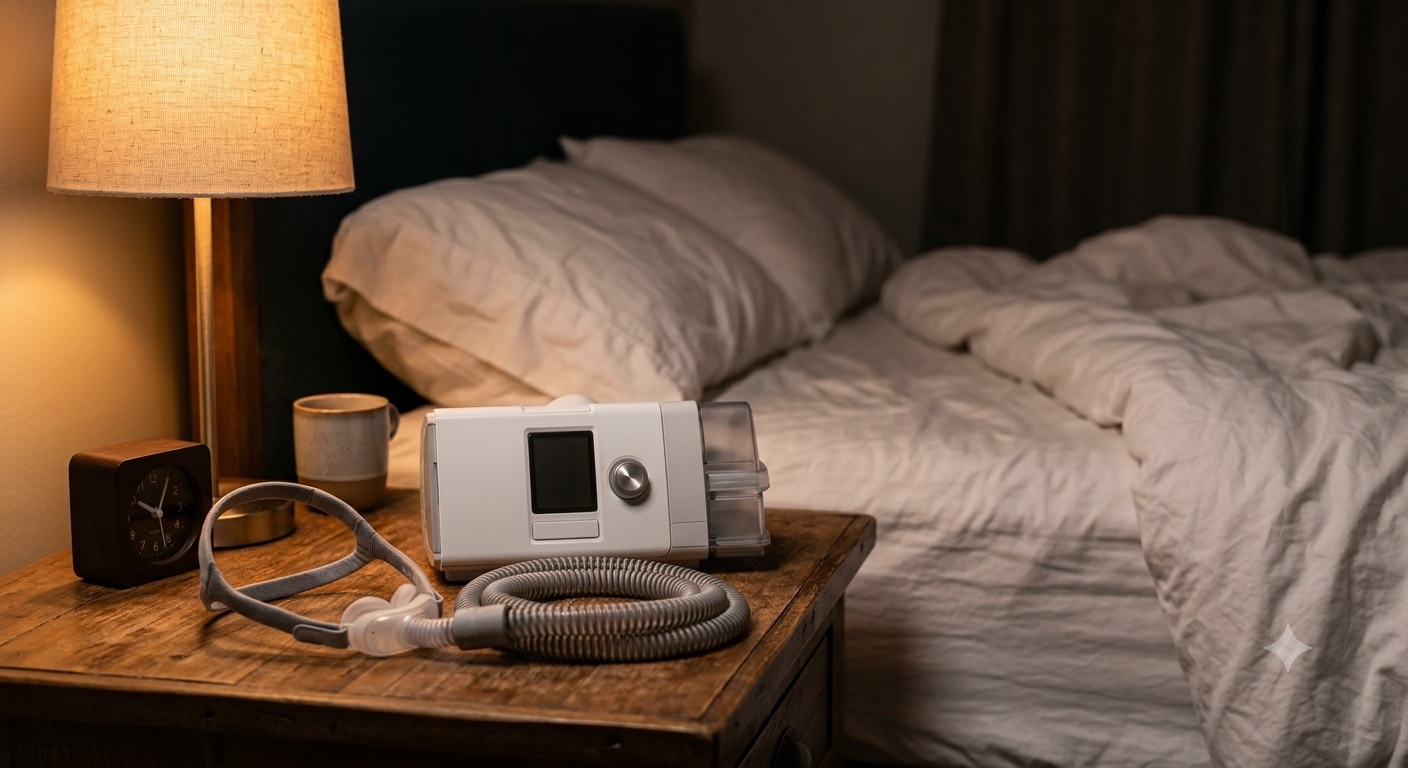
A small bedside machine, a hose, and a mask. The machine is not an oxygen tank and does not breathe for you — it simply pressurizes ordinary room air, usually with heated humidification for comfort.
In OSA, the throat muscles relax during sleep and the airway collapses. CPAP works as a pneumatic splint: gentle, continuous air pressure holds the airway open so breathing pauses, oxygen dips, and repeated awakenings simply cannot happen.
Used consistently, CPAP reduces daytime sleepiness, improves alertness and mood, lowers blood pressure, and reduces the long-term cardiovascular strain of untreated apnea. Many people notice better mornings within the first weeks.
What patients need to know before starting
- Your pressure is prescribed. The setting comes from your sleep study or an auto-titrating (APAP) machine that adjusts within a prescribed range. Don't change settings on your own — call your sleep clinic if something feels wrong.
- It treats, it doesn't cure. CPAP controls sleep apnea only on the nights you use it. Stop, and the apnea returns immediately — so plan on using it every night, including naps and travel.
- The first month sets the pattern. Expect an adjustment period. Mask comfort, humidification, and the ramp feature solve most early problems — the sections below walk through each one.
- Follow-up is part of the therapy. See your sleep provider or DME supplier within the first couple of weeks, and review your machine's data (usage hours, AHI, leak) together. Small adjustments early make the difference between quitting and succeeding.
- Tell your care team what else is going on. Nasal congestion, weight change, new medications, alcohol, and surgery can all change your pressure needs — mention CPAP at every medical visit.
For more on how sleep apnea itself is diagnosed, see our sleep apnea overview. For alternatives when CPAP isn't tolerated, see advanced OSA therapies.
The numbers that matter
CPAP is most effective when used every night for the entire sleep period. Even a few hours each night helps, but consistent all-night use produces the best outcomes — and early habits predict long-term success.[1]
Most insurance plans (including Medicare) define adherence as at least 4 hours per night — a minimum, not a goal. More use is better.[1]
Adherence is measured over a 30-day period: 4+ hours on at least 70% of nights. Starting every night with the mask on builds the habit.[1]
The first month is the strongest predictor of long-term success. Early follow-up and early troubleshooting make a real difference.[1]
Even if you remove it partway through at first, start each night with it on. The habit is the therapy.
Wear the mask while reading or watching TV to get used to the sensation before adding sleep.[2]
Most machines can start at a lower pressure and gradually ramp up, making it easier to fall asleep.
Going to bed and waking at the same time helps you associate CPAP with your routine.
Contact your sleep clinic or DME provider within 1–2 weeks of starting. Don't wait months to address problems.
Modern machines track usage, AHI, and leak. Ask your sleep provider to review your data and adjust as needed.
Find the right mask
The mask is the single most important factor in comfort and adherence. There is no single "best" mask — the best mask is the one you will wear.[1] Compare the three main styles, then try the mask finder below.
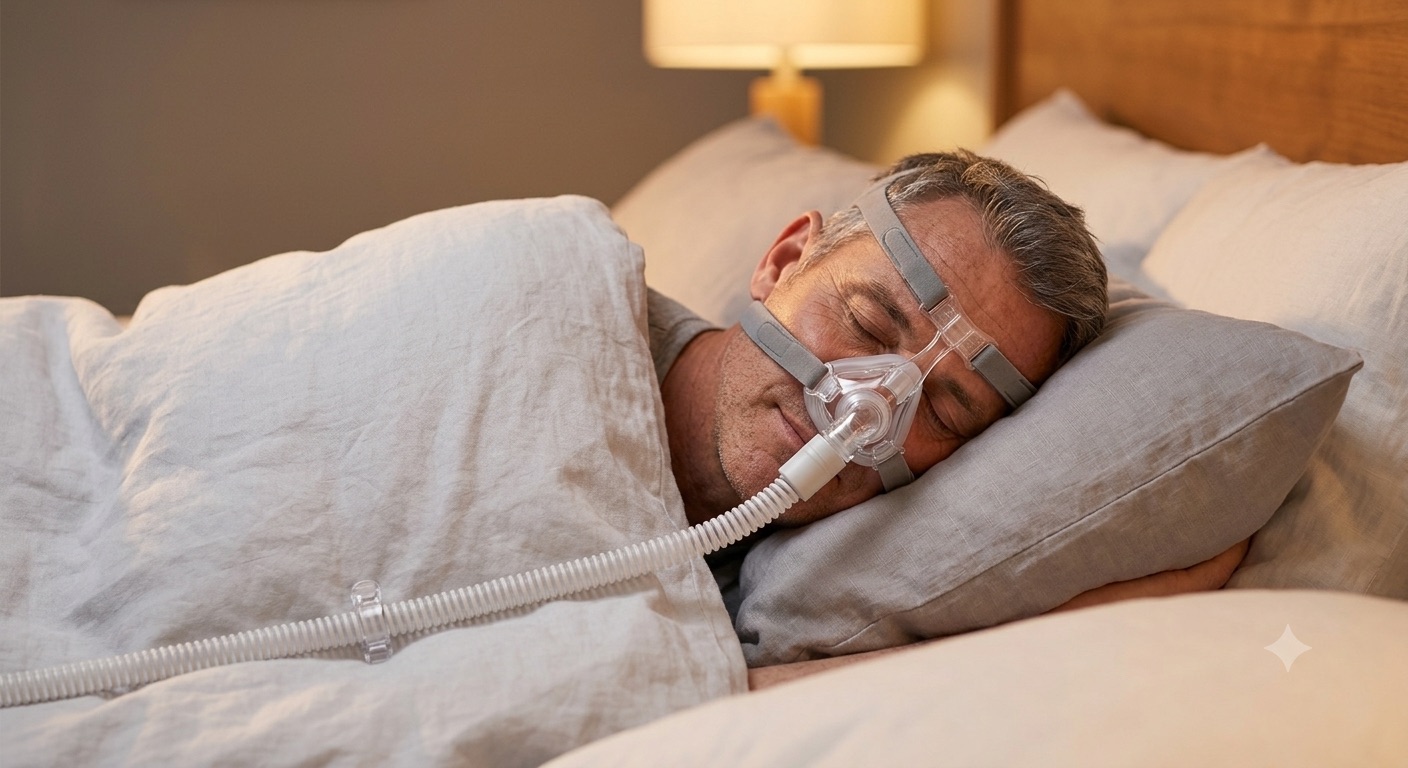
Nasal mask — covers the nose only
The most common style and often the best first choice. Clinical data suggest nasal masks are associated with better adherence and lower leak rates than full-face masks — and they typically control sleep apnea at lower pressures.[1,8]
Best for- Mouth leaks if you breathe through your mouth — try a chin strap before switching styles.[5]
- Pressure on the bridge of the nose — don't overtighten; a well-fitting mask should not hurt.
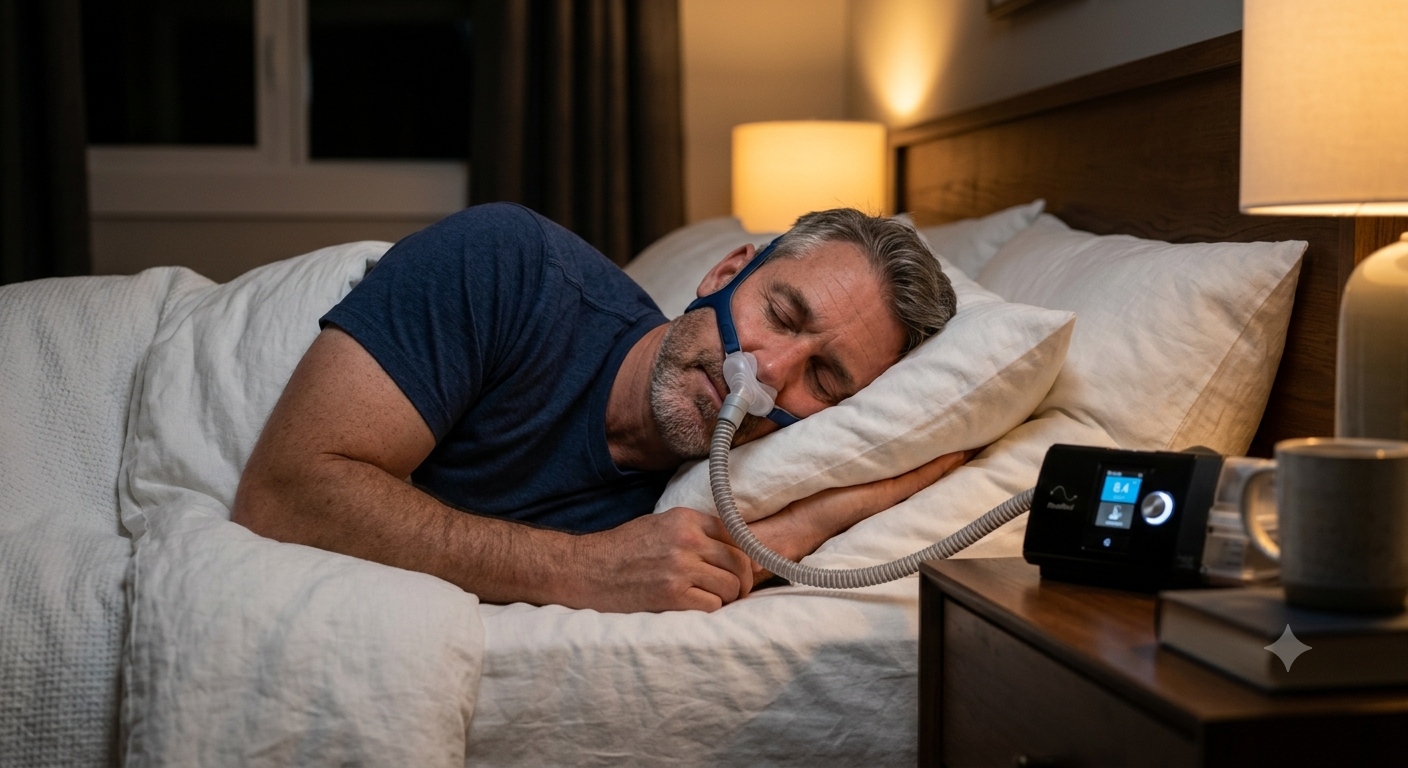
Nasal pillows — seal gently under the nose
Soft cushions that sit at the nostrils with minimal facial contact — the least "mask-like" style. Your field of vision stays open, glasses fit, and many people find it the easiest to tolerate.
Best for- Airflow can feel forceful at very high pressures — a standard nasal mask may be more comfortable.[4]
- Nostril dryness or soreness — heated humidification usually helps.
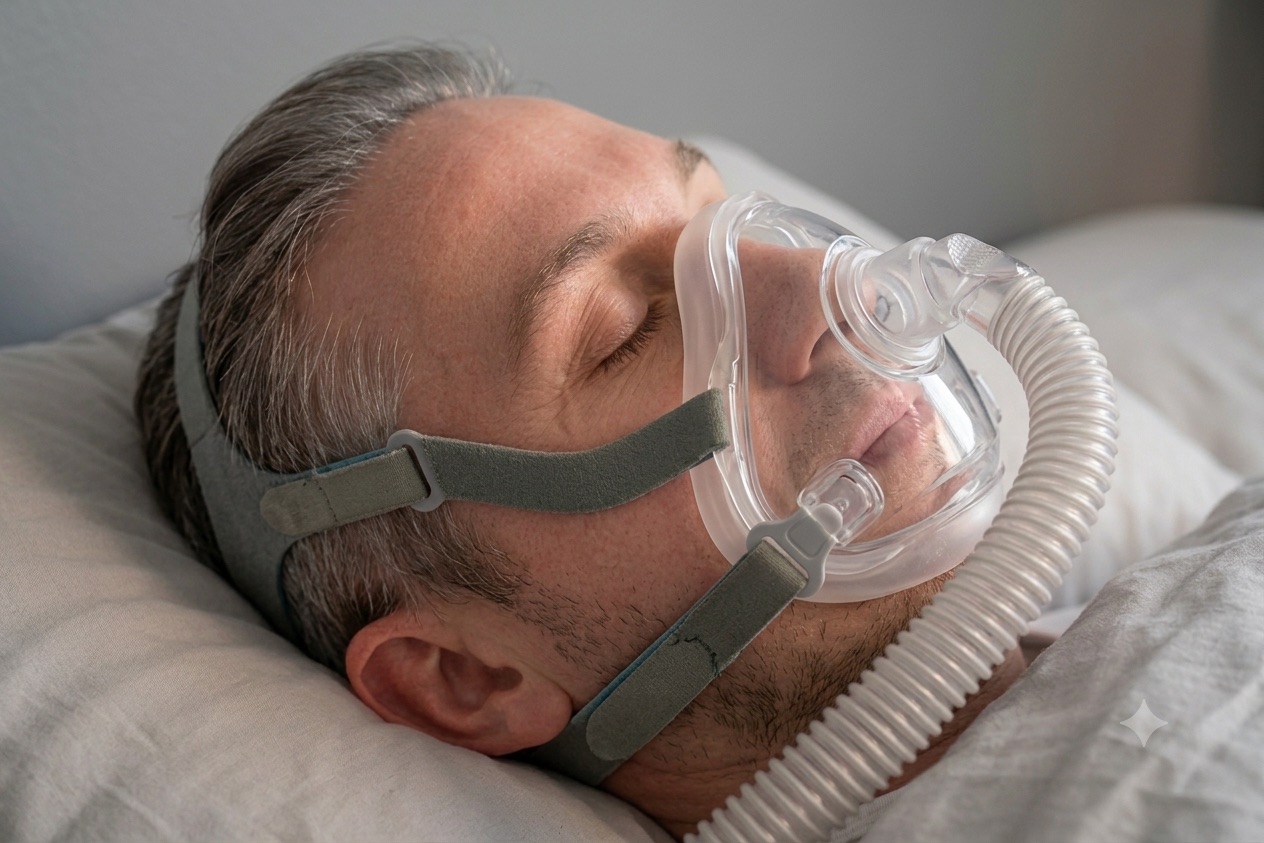
Full-face (oronasal) mask — covers nose and mouth
Works no matter how you breathe. Needed if you breathe through your mouth or if nasal masks cause persistent mouth leaks — larger and heavier, but the right choice for the right patient.[1]
Best for- More surface area means more potential leak paths and higher leak rates on average.[1]
- Full-face masks typically need higher pressures to achieve the same control — about 2 cm H2O more on average, with more residual apnea events. A high pressure setting by itself is not a reason to switch to a full-face mask.[8,9]
- Beards and mustaches break the seal — nasal pillows usually seal well despite facial hair.[5]
- Frequent congestion deserves its own evaluation (allergies, septal deviation, polyps).
Sizing varies between brands — a "small" in one mask is not a "small" in another, so always try on and adjust with your provider or supplier.[4] For labeled photos of every style, see the Mayo Clinic CPAP mask guide.
Mask finder: answer 6 quick questions
Match the mask to how you breathe, how you sleep, and what you need to feel comfortable.[4,5] This is education, not a prescription — confirm the fit with your sleep team or DME supplier.
1. How do you mostly breathe when you sleep?
2. What's your usual sleep position?
3. Do masks or enclosed spaces make you anxious?
4. Do you have a beard or mustache?
5. Do you wear glasses, read, or watch TV in bed?
6. Is your nose often congested or blocked at night?
0 of 6 answered
Every face is different — use this as a starting point for a fitting with your provider, ideally lying down in your usual sleep position. Many suppliers allow mask exchanges in the first 30 days.[5]
Mask fit tips
- Get fitted properly: A mask fitting with a trained technician or DME specialist is recommended before starting therapy.[2]
- Try before you commit: Many DME providers allow trial periods. Take advantage of this.
- Don't overtighten: A mask that is too tight causes pressure sores and actually worsens leaks. Tighten just enough to seal.
- Lie down during fitting: The seal changes between sitting and lying. Fit the mask in the position you sleep in.
- Re-evaluate if comfort declines: As cushions wear out, the seal worsens. Replacing cushions regularly maintains fit.
Signs your mask is wrong (and what to try)
- Red marks, sores, or pain: Too tight or the wrong size. Loosen the straps, try strap covers or a mask liner, or refit.[5]
- Air blowing into your eyes: The mask sits too high or the cushion is worn. Reposition, replace the cushion, or resize.[5]
- Dry mouth on a nasal mask: You are likely mouth-leaking. Try a chin strap and more humidification first; if that fails, switch to a full-face mask.[5]
- High leak numbers on your app/report: Refit lying down in your sleep position; check cushion wear; consider a different size or style.
- Persistent discomfort after 2 weeks: Don't tough it out — contact your sleep team or DME supplier.[5]
- Weight change: Significant weight gain or loss changes face shape and seal. Ask for a fit check.[5]
Accessories that make CPAP easier
Simple, inexpensive add-ons solve many of the most common comfort problems. Most are available without a prescription.[6] Tap any add-on to learn more.
Chin strap
- A soft, adjustable band that cradles the jaw to keep the mouth closed during sleep.
- Best for people who like their nasal or nasal pillow mask but leak air through the mouth (dry mouth on waking, high leak on reports).[5,6]
- Try it before switching to a full-face mask — many people keep the smaller, more comfortable mask this way.
- Snug enough to support the jaw, not clamp it — and it should not pull the jaw backward.
Mouth tape
- Specialized porous, skin-safe tape placed over closed lips to reduce mouth leak with nasal masks — some people prefer it to a chin strap.
- Cautions: Use only tape designed for skin/lips, and only as an adjunct during CPAP — taping is not a treatment for sleep apnea by itself. Avoid it with significant nasal obstruction, make sure you can remove it easily, and discuss with your sleep clinician first.
CPAP pillow
- A bed pillow with side cutouts that give the mask and hose room, so side sleeping doesn't push the mask off its seal.[6]
- Most helpful for side and stomach sleepers using nasal or full-face masks.
Hose holder / tubing management
- A stand or hook that suspends the hose above the headboard so it doesn't drag on the mask, tangle, or wake you when you turn over.[6]
- Low-tech alternatives: lay the tubing on your chest under the blanket, or route it behind the headboard. "Top-of-head" connection masks solve the same problem by design.[6]
Mask liners & strap covers
- Mask liners: Thin fabric barriers between cushion and skin — reduce irritation, leaks, and moisture.[5]
- Strap covers: Soft fleece sleeves that prevent strap marks and rubbing.[7]
Heated humidifier & heated tubing
- Reduce nasal dryness and congestion — often the difference between tolerable and comfortable therapy.[6]
- Heated tubing prevents "rainout" condensation in the hose while allowing higher humidity settings.[6]
The comfort ladder: 5 steps at your own pace
If the mask triggers anxiety or claustrophobia, don't force full nights right away. Gradual daytime practice — desensitization — builds comfort with each step before adding the next.[2,5] Check off each step as you master it; your progress is saved on this device.
0 of 5 steps completed
All five steps — well done. Keep the routine going every night, and share your progress with your sleep team.
Most people move through these steps over days to a couple of weeks. Repeating a step is normal — it's practice, not failure.[5]
Extra strategies that help
- Slow breathing and relaxation: Practice slow breathing, relaxation exercises, or meditation while wearing the mask — anxiety eases as breathing slows.[5]
- Ramp and pressure relief: Start pressure low (ramp) and use expiratory pressure relief settings while acclimating.
- Downsize the mask: Claustrophobia usually improves with less facial coverage — try nasal pillows.[5]
- Keep the routine even on hard nights: Some use is better than none, and nightly consistency builds tolerance fastest.[2]
- Ask for help early: Sleep technologists can coach desensitization, and talk therapy (CBT) is effective for persistent CPAP-related claustrophobia or anxiety.[5]
Keeping your equipment clean
Regular cleaning maintains comfort, extends equipment life, and reduces odor buildup. Follow your manufacturer's instructions.[3]
- Wipe the mask cushion with a damp cloth or unscented baby wipe to remove facial oils — oils break down silicone and reduce the seal over time.
- Empty the humidifier chamber. Do not leave standing water in the chamber during the day.
- Refill with distilled water at night. Distilled water prevents mineral buildup; tap water leaves white deposits and shortens chamber life.
- Wash mask cushion, headgear, and tubing in warm water with mild, unscented soap. Rinse thoroughly and air dry. No harsh chemicals, bleach, or alcohol.
- Wash the humidifier chamber with warm soapy water. Rinse and air dry completely.
- Check reusable filters — rinse and air dry. Replace disposable filters on the schedule below.
Skip the ozone and UV cleaners
The FDA has warned that ozone-generating CPAP cleaners have not been approved and may cause respiratory irritation. Soap and water is sufficient.[3]
When to replace your supplies
Supplies wear out with regular use, and worn cushions are a leading cause of leaks and declining comfort. Most insurance plans cover replacements on a defined schedule — contact your DME supplier to confirm your eligibility.
- Disposable filters (check your machine's specifications)
- Nasal pillow cushions (monthly)
- Mask cushion
- Full mask frame
- Tubing / hose
- Headgear and chin strap
- Reusable filter (wash weekly)
- Humidifier water chamber
- CPAP machine (or as needed)
These are general guidelines — your insurance plan's replacement schedule may vary.
Common problems and solutions
Mask leaks
- Refit the mask — loosen slightly and reseal. Overtightening usually makes leaks worse.
- Check that the cushion is not worn, cracked, or flattened. Replace if needed.
- Facial hair can break the seal. Trimming or shaving the area under the cushion may help.
- Try a different mask style if leaks persist despite proper fit and a new cushion.
- A small amount of leak is normal — machines compensate automatically. Only excessive leak (shown on your report or app) needs to be addressed.
Nasal congestion or dryness
- Turn up the heated humidifier setting. Increasing humidity reduces nasal dryness, congestion, and nosebleeds.
- Use heated tubing if available — this prevents condensation ("rainout") while allowing higher humidity.
- Saline nasal spray before bed can help with dryness.
- If congestion is persistent, discuss nasal corticosteroid sprays with your clinician.
- Significant nasal obstruction may warrant evaluation (deviated septum, polyps, allergies).
Discomfort, claustrophobia, or pressure intolerance
- Use the ramp feature to start at a lower pressure and gradually increase.
- Try APAP (auto-adjusting PAP) if fixed CPAP pressure feels too high — many machines can be set to auto-adjust within a range.[1]
- Work through the comfort ladder above to desensitize gradually.[2]
- Try a nasal pillow mask if full-face or nasal masks feel confining.
- Pressure relief settings (EPR, C-Flex, A-Flex) reduce exhalation pressure and may improve comfort.
- Discuss BiPAP with your sleep provider if single-pressure therapy remains intolerable despite these adjustments.
Removing the mask during sleep
- This is common, especially in the first weeks. Don't give up — the habit often improves with time.
- Check for leak or pressure issues that may be waking you up.
- Set an alarm for 4 hours after bedtime to check if the mask is still on (as a temporary awareness strategy).
- Address any underlying congestion, claustrophobia, or discomfort that may be causing removal.
- Some people find it helpful to go to bed slightly later (to increase sleepiness) so they fall asleep more quickly with the mask.
Trusted resources
- AASM Sleep Education: CPAP — benefits, side effects, mask types, and tips
- Mayo Clinic: Which CPAP masks are best for you? — photos of each mask style
- Mayo Clinic: Avoiding 10 common CPAP problems
- ATS: PAP Therapy — Quick Troubleshooting Tips
- NHLBI (NIH): CPAP
- AASM: Obstructive Sleep Apnea
- ATS: OSA in Adults (PDF)
Related topics
- Obstructive sleep apnea
- Advanced OSA therapies — beyond CPAP
- Sleep Health & Wellness
- Insomnia — can coexist with OSA
- Sleep–Lung Connection
References
- Patil SP, Ayappa IA, Caples SM, Kimoff RJ, Patel SR, Harrod CG. Treatment of adult obstructive sleep apnea with positive airway pressure: an American Academy of Sleep Medicine clinical practice guideline. J Clin Sleep Med. 2019;15(2):335-343. doi:10.5664/jcsm.7640
- Kushida CA, Chediak A, Berry RB, et al. Clinical guidelines for the manual titration of positive airway pressure in patients with obstructive sleep apnea. J Clin Sleep Med. 2008;4(2):157-171. doi:10.5664/jcsm.27133
- Patel SR. Providing cleaning recommendations for positive airway pressure devices. Ann Am Thorac Soc. 2024;21(1):27-29. doi:10.1513/AnnalsATS.202308-683VP
- Mayo Clinic Staff. Which CPAP masks are best for you? Mayo Clinic; updated Jan 31, 2024. mayoclinic.org
- Mayo Clinic Staff. CPAP machines: Tips for avoiding 10 common problems. Mayo Clinic; updated Jan 21, 2026. mayoclinic.org
- Schotland H. PAP Therapy — Quick Tips for Troubleshooting to Address Problems with Use. American Thoracic Society Patient Education Series. Am J Respir Crit Care Med. 2021;204:P9-P10. thoracic.org
- American Academy of Sleep Medicine. CPAP. Sleep Education; reviewed Aug 2020. sleepeducation.org
- Deshpande S, Joosten S, Turton A, et al. Oronasal masks require a higher pressure than nasal and nasal pillow masks for the treatment of obstructive sleep apnea. J Clin Sleep Med. 2016;12(9):1263-1268. doi:10.5664/jcsm.6128
- Genta PR, Kaminska M, Edwards BA, et al. The importance of mask selection on continuous positive airway pressure outcomes for obstructive sleep apnea. An official American Thoracic Society workshop report. Ann Am Thorac Soc. 2020;17(10):1177-1185. doi:10.1513/AnnalsATS.202007-864ST